
Acceleration
I feel like I am constantly racing against time, yet no matter how fast I run I always seem to be losing.

I feel like I am constantly racing against time, yet no matter how fast I run I always seem to be losing.
It is a mathematical truth that the more you live, the less significant each additional year becomes. At the age of two, your third year of life constituted 1/3rd (33%) of your existence. At the age of 49, your 50th year will constitute a mere 1/50 (2%).
This calculation partially explains why every year feels faster than the last; yet it fails to account for the rate — and intensity — of that acceleration. It fails to account for the experience of that acceleration; that feeling of free falling through space, drunkenly stumbling over one’s furniture, turning on phones and refrigerators and computers only to forget what you wanted in the first place.
Indeed, this is an acceleration that seeps – into our institutions, culture, daily lives, and self-identities. We have structurally directed the burden of proof toward permanence while moralizing mobilisation. Consequently, our cultural insistence to do more in less time has created an irrevocable desynchronization between our sense of self and our lived experiences and environments; between the institutions which govern and the pace at which the governed world evolves; stripping us of context, of coherence, of autonomy, and of democracy.
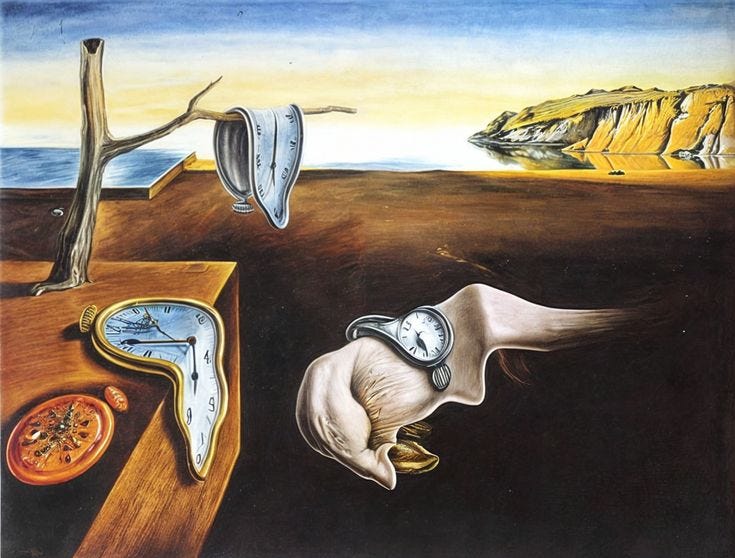
In making this argument I draw heavily on Harmut Rosa’s Social Acceleration: A New Theory of Modernity. Rosa argues that modernity, at its core, is a temporal phenomenon – it not only inhabits a position in time, but contorts time itself. This is significant because time is the ultimate mediator between social structures and individual subjectivity. Socially-produced temporal structures – calendars, deadlines, milestones – frame not only how we live, but our conception of what it means to live, and to live well. They determine when we work, when we sleep, and when we rest; they pace the rhythm at which we progress through life itself, from little league baseball to retirement. Thus, the impetus for acceleration that anchors modern time too defines modern life itself.
How, then, does acceleration play out in modern life? It comes in three forms:
1. Technological acceleration,
2. Acceleration of social change,
3. Acceleration of the pace of life.
Technological acceleration entails the speeding up of goal-directed processes through technology; the application of technology to reduce the amount of time it takes to achieve a given task. Technological acceleration is witnessed through advancements in transportation, mass communication, mass production, data processing, and beyond. These advancements reveal an underlying paradox: new technologies which should logically free up more time instead further propels acceleration.
Acceleration of social change defines the quickening rate at which knowledge, social institutions and identities become obsolete. It occurs due to the rapid contraction of the present – the period in which past experiences reliably guide future expectations. As the window of the present shrinks, change goes from intergenerational (changing between generations) to intragenerational (changing within generations): the world we inherit from our parents begins to expire in real time. Social acceleration – and the instability it cultivates – thus fosters a deep fear of commitment, for one can never be sure that the decisions they make today will still be relevant tomorrow.
Acceleration of the pace of life then describes the brute attempt to do more per unit of time. We are talking faster, eating faster, scrolling faster. We are power napping and speed dating. We are multitasking. Movies are getting shorter, and so are advertisements. Acceleration of the pace of life explains the paradox of technological acceleration, for the amount of things we feel compelled to do grows faster than the speed at which we can do them. The twenty minute commute shortened to ten does not result in ten minutes of leisure, but rather ten minutes occupied by a new obligation; despite improvements in public transportation, commuting no longer suffices as a “good” use of twenty minutes.
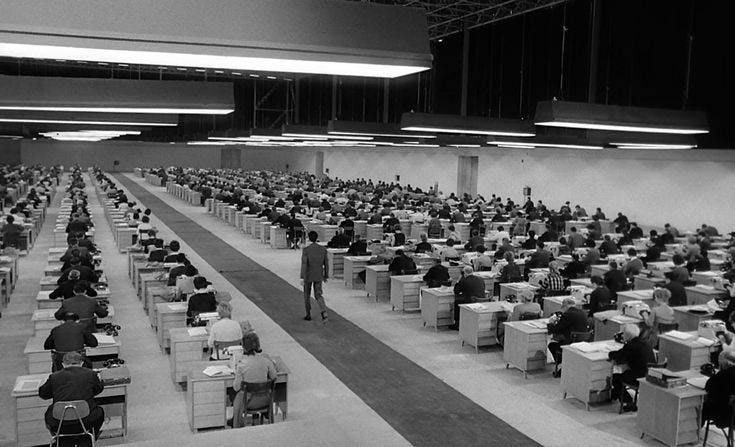
These three forms of acceleration reinforce each other in a self-propelling circle. Technological acceleration promotes social acceleration by drastically altering the present world and rendering pre-existing things obsolete. The acceleration of social change in turn mandates constant negotiation, adaptation and decision-making, quickening the pace of life. The accelerating pace of life then demands new technological forms to free up more time, in order to achieve even more in less time.
The convergence of these three forms of acceleration consequently induces profound desynchronization at both the individual and collective level.
At the individual level, our conception of time – and in turn our lives – are rendered incoherent. We are constantly threatened by an existential urgency; the sensation that time is slipping through our fingers, that we are not doing enough no matter what. Simultaneously, daily life in an ever-evolving world imposes an unforeseen demand for decision-making; decision-making which requires slow, inward reflection and the tiresome pursuit of knowledge. The clashing of that irresistible urgency and the pervasive demand for choices results, oftentimes, in renunciation: we decide not to decide at all. We outsource the intellectual labor of figuring out what to do with one’s self to society, to parents – or worst yet, to distractions which perpetually postpone the necessity of decision-making.
In distractions we lose ourselves. It begins with the incessant stream of pings that cloud our daily functioning, and ends with the Netflix episodes that blend into binged seasons in the few hours we spend at home each night. Here it is useful to borrow philosopher James Williams’ theory, which identifies three 3 types of attention:
Doing - spotlight- functional distraction
Knowing - daylight - epistemic distraction
Being - starlight - existential distraction
The voluntary and involuntary forms of distraction to which we’re subjected in the spotlight and daylight culminates in distraction under the starlight. The daily “drifting” induced by our inability to concentrate on a singular task, coupled with our natural resort to seductive content that colonizes our minds in the little leisure we do find, is stripping us of both the ability to conceptualize and to achieve purpose. Through distraction we are estranged from our personal goals; excused from justifying and grappling with our being. Through distraction we are estranged from our desires, spending our precious free time optimizing tech companies’ engagement metrics rather than learning a new instrument; trying a new recipe; enjoying the summer breeze in the park; reading a new book; breathing; thinking; acting. Through distraction we become existentially lost.
This is the underpinning of the sense of acceleration which defines modern life: the living of life through a decontextualized self, one who cannot situate experiences within a broader narrative, both of who one is as an holistic individual and of the expansive, historical world they inhabit. Self-identity is rendered entirely situational, constantly defined and redefined by its immediate context with little continuity.
Acceleration introduces a similar estrangement at the collective level, within the political sphere. Ironically, stable rules-based institutions initially erected to permit acceleration are outpaced by the transformations they sprouted and were designed to govern. Similar to its effect at the individual level, the shortening of the present collapses the time horizon allotted to institutional decision-making, all while the number and scope of necessary decisions grow. The mismatch between the rate of change and the speed at which governance and collective deliberation occurs introduces what Rosa coins the “frenetic standstill”: a world in which visible, surface-level evolution appears constant, yet little evolves beneath the surface. As market configurations, information cycles, cultural trends, and technological innovation fluctuate constantly, creating the illusion of progress, the fundamental distribution of wealth and power only becomes evermore rigid.
The paralysis of democratic institutions then results in the relocation of decisions into faster systems, such as deregulation, privatization, and the preponderance of executive over the legislative. Thus, acceleration’s erosion of individual will is accompanied by its erosion of collective will, expressed through democracy. Acceleration, which necessarily severs itself from democratic governance, is oligarchy.
I do not dare offer solutions for the restoration of democracy, though I do know that naturally, the antidote to acceleration is deceleration. At the individual level, the recentering of one’s core sense of self is achieved through an active effort to reject the myriad of distractions to which we are subjected. This recentering mandates responsiveness, to our internal and the external worlds. It demands attention paid to the moments which stir and trigger; efforts made to fall in and fall deeply; knowledge, feelings, and observations synthesized to form opinions and power introspection. It demands a profound commitment to live despite the persistence of structures which render living’s natural manifestations unnatural.
Evidently the resolution of the collective challenge requires far more than individual will – how does one cultivate deceleration at a political, institutional level? Perhaps the answer rests similarly in the promotion of acts which resist optimization – in the preservation of liberal arts education, investment in art, protection of workers, and an undying defense of democratic deliberation.
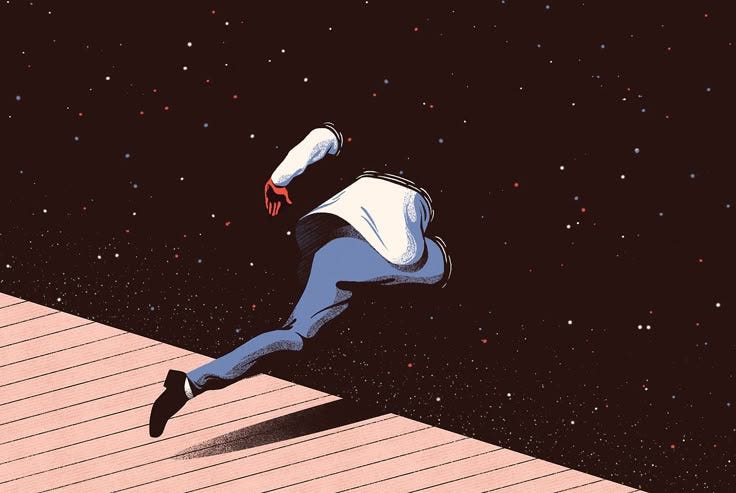
For now, I rescind my position in the race, yet nonetheless I run onwards. Toward the starlight.
so scary!